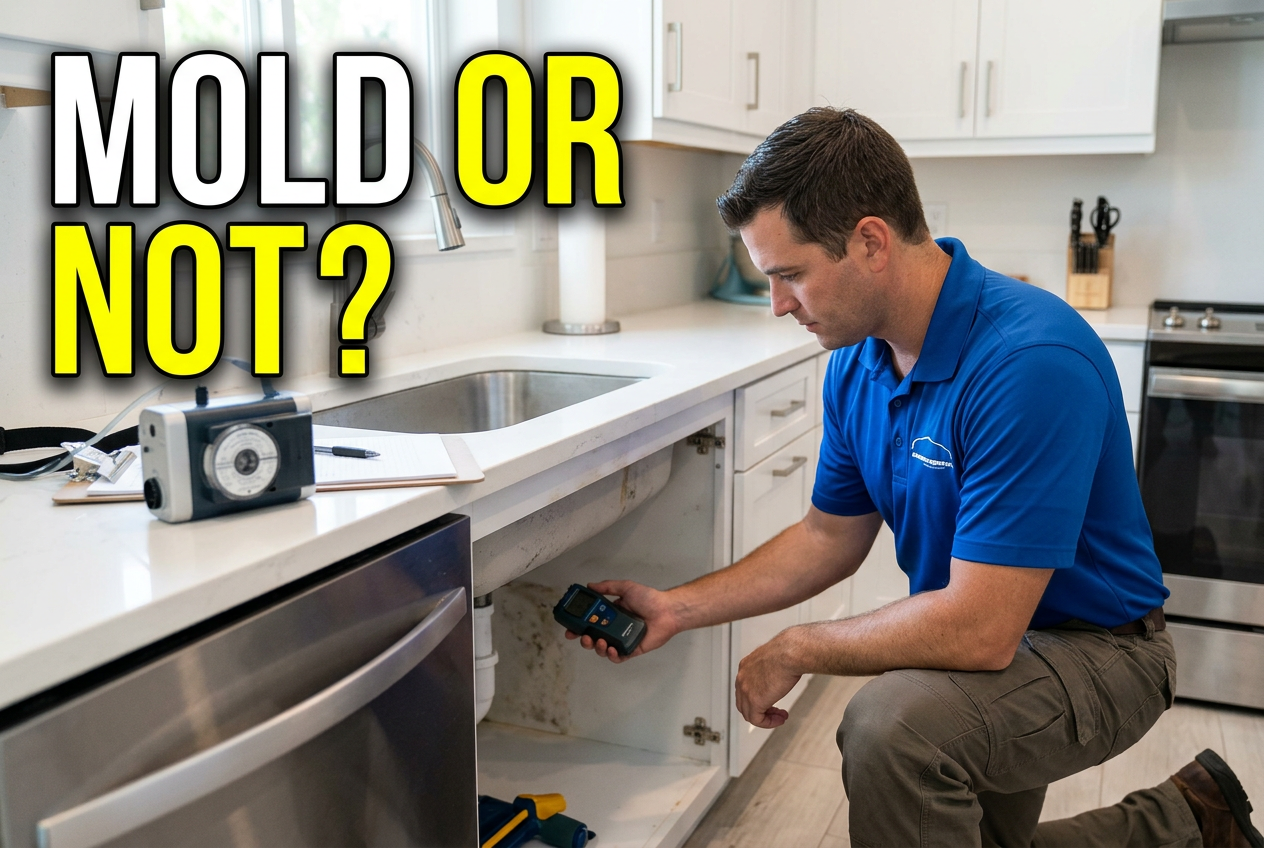
If you are concerned about possible mold in a Delray Beach home or building, you may be wondering whether to book mold testing, a mold inspection, or both. The services are related, but they answer different questions. An inspection looks for visible conditions and moisture concerns; testing analyzes selected samples. Neither service, by itself, can explain every cause, health concern, or repair need.
Key Takeaways
- A mold inspection evaluates the property for visible mold, moisture, and conditions that may support growth.
- Mold testing analyzes specific air or surface samples, but results represent the samples and conditions at the time they were collected.
- Testing is not always necessary when visible growth and a moisture source are already apparent.
- Neither an inspection nor a test can guarantee that a property is completely mold-free or diagnose a person’s symptoms.
- In Delray Beach, leaks, humidity, air-conditioning issues, and water intrusion are reasons to investigate moisture—not proof of mold on their own.
What a Mold Inspection Can Tell You
A mold inspection is an evaluation of the property and the conditions that may contribute to mold growth. Depending on the assignment and access to the building, an inspector may look for visible growth, water staining, condensation, musty odors, and signs of past or ongoing moisture. The inspection may also include moisture measurements and thermal imaging as a tool for identifying temperature patterns that warrant closer investigation.
In Delray Beach, a practical inspection may consider areas such as bathrooms, kitchens, laundry rooms, air-conditioning equipment and nearby surfaces, closets, attics, and locations below plumbing or roof penetrations. South Florida’s warm, humid conditions can make moisture control important, but the climate alone does not establish that mold is present in a particular home.
An inspection can help identify where a concern may be located and whether there are observable clues to investigate further. It may also help distinguish an obvious moisture issue from a concern that needs additional assessment. A report can document findings and limitations, such as areas that were inaccessible or concealed behind finishes.
What it cannot answer: A visual inspection cannot confirm the identity or concentration of mold that is not sampled. Thermal imaging does not see mold or moisture directly; it shows temperature differences that can have multiple explanations and may need confirmation with other methods. An inspection also cannot guarantee that hidden mold is absent from every wall cavity or other inaccessible space.
What Mold Testing Can Tell You
Mold testing generally means collecting one or more samples for analysis. Depending on the purpose of the assessment, a professional may collect air or surface samples. A laboratory may report the types or quantities of mold-related particles detected in those particular samples. Sampling locations and methods should be selected to address a specific question rather than treated as a substitute for examining the property.
Testing may be useful when there is a concern that cannot be resolved by observation alone, when a client needs documented sample results, or when an inspector believes targeted sampling could add relevant information. A professional can explain what the proposed samples are intended to assess and what conclusions would be reasonable from the results.
What it cannot answer: A sample is a snapshot—not a complete inventory of a building. Results can be influenced by where and when sampling occurs, building conditions, and the sampling method. A negative result does not prove that mold is absent elsewhere or that conditions will remain unchanged. A positive result does not, by itself, identify the moisture source, establish how long growth has been present, or determine the cause of anyone’s symptoms.
There is also no single test result that automatically describes a home as safe or unsafe in every situation. Results need to be interpreted in context, including the inspection findings, sampling locations, and the reason testing was requested.
Inspection or Testing: Which Should You Choose?
The right starting point depends on what you know and what you need to find out. If you notice a musty odor, recurring condensation, water staining, or a history of a leak, a mold inspection may help evaluate the affected area and look for moisture clues. If there is visible growth and a clear source of water, sampling may not be needed to establish that a moisture and mold concern exists. A qualified professional can explain whether testing would add useful information.
If you have no visible signs but want a specific question addressed—for example, whether selected indoor air samples show mold particles under the conditions present during sampling—testing may be considered as part of a broader assessment. It is helpful to discuss the goal before samples are collected. Broad or untargeted sampling may produce results that are difficult to interpret or do not resolve the underlying concern.
Some situations call for inspection and testing together; others call for inspection without sampling. Ask what the proposed service includes, what areas can be accessed, whether laboratory analysis is involved, and what the report will and will not conclude. If a property has an active leak or another obvious source of water, addressing that source is important; sampling alone does not correct moisture conditions.
Warning Signs Worth Investigating in Delray Beach
Consider a professional evaluation if you find recurring dampness, visible spots or staining, a persistent musty odor, peeling or bubbling finishes, or repeated condensation near cooling equipment or windows. A past roof, plumbing, appliance, or storm-related water event may also be relevant, particularly if materials remained wet or odors developed afterward.
These signs do not prove that mold is present, and some can have causes unrelated to mold. Conversely, the absence of visible growth does not rule out a concealed moisture problem. Avoid disturbing suspected growth before understanding the situation, especially if doing so could spread dust or damage building materials. If the concern is a health symptom, consult a qualified healthcare professional; a mold inspection is not a medical evaluation.
Choosing an Independent Mold Inspector
When comparing providers for mold testing in Delray Beach, FL, ask whether the company explains its inspection and sampling methods, documents limitations, and provides a clear account of findings. Independence can be useful to property owners who want an assessment from a company that does not also sell remediation work. That does not mean every company offering multiple services has a conflict; it is reasonable to understand how a provider is compensated and what services it performs.
MoldXperts provides independent mold inspection, mold testing, indoor air quality testing, and thermal imaging as part of mold and moisture inspections in South Florida. The company does not provide mold remediation or mold removal. Its service area includes Palm Beach County, along with Broward and Miami-Dade counties.
Watch: MoldXperts on YouTube
For more information about mold inspections and testing, visit the official MoldXperts YouTube channel.
Schedule a Delray Beach Mold Inspection or Test
If you have a moisture concern, unexplained odor, or questions about which service fits your situation, contact MoldXperts to discuss a professional, independent assessment in Delray Beach. MoldXperts serves Broward, Miami-Dade, and Palm Beach counties. Call (954) 464-4538 or visit the website to learn more.



Leave a Reply