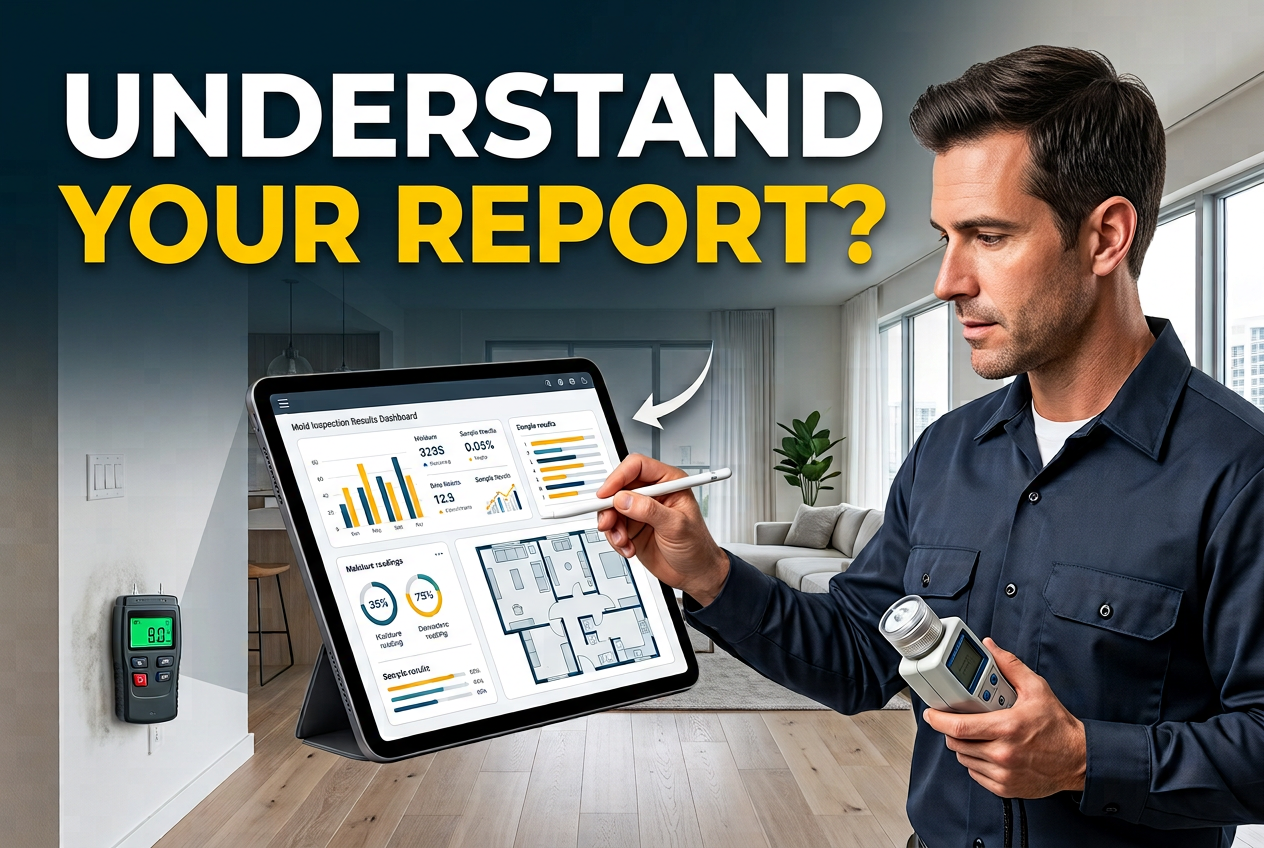
A mold inspection report can include photographs, moisture measurements, notes about building conditions, and laboratory results. For Miami property owners, knowing how these parts fit together can make the findings easier to understand and help clarify what questions to ask next. A report is an assessment of conditions observed or tested at a particular time—not a guarantee that every hidden area is free of mold or moisture.
Key Takeaways
- Read the observations, moisture findings, and lab results together rather than treating any one item as a complete conclusion.
- Moisture readings are clues about conditions at tested locations; their meaning depends on the material, instrument, and comparison points.
- Air or surface sample results describe the samples collected, not every room or hidden space in the property.
- A report can help identify areas for follow-up, but it does not diagnose health conditions or establish that a building is entirely mold-free.
Start with the scope and limitations
Before reviewing individual findings, check the report’s date, the areas inspected, the inspection methods used, and any access limitations. Note whether the inspector could enter closets, attics, crawlspaces, or other relevant areas, and whether furnishings or finishes blocked access. The report should make clear what was included and where further evaluation may be appropriate.
Conditions can change after an inspection. In Miami, heavy rain, plumbing leaks, air-conditioning issues, and high outdoor humidity can affect indoor moisture conditions. A report reflects the conditions present during the visit and the methods used at that time. If a leak or other water event occurs afterward, the earlier findings may no longer describe the current situation.
How to interpret visual observations
Visual observations document what the inspector could see, such as staining, suspected microbial growth, water-damaged materials, condensation, or musty odors. Photographs and notes should identify the location and describe the observed condition. Look for details that connect a visible concern with a possible moisture source—for example, staining near a window, an affected cabinet below a sink, or discoloration around an air-conditioning component.
Visual observations are not always enough to determine what is behind a wall, under flooring, or inside a ceiling assembly. A stain may remain after a past leak has been repaired, while a concealed moisture problem may not be visible at all. The report may recommend additional evaluation if the inspector sees indicators that warrant it. Ask what evidence supports the recommendation and what area or question the proposed follow-up is intended to address.
What moisture readings can—and cannot—tell you
Moisture meters measure or estimate moisture in materials at specific locations. Depending on the instrument and material, readings may be displayed as a number, percentage, relative scale, or simple indicator. Review the report’s explanation of the meter and its results. A reading is most useful when considered alongside the material tested, nearby comparison readings, visible conditions, and the building’s history.
There is no single number that means the same thing for every building material or instrument. Metal, salts, material density, surface coatings, and other conditions can affect some readings. A high or unusual result can indicate an area worth investigating, but it does not by itself identify the source of moisture or prove that mold is present. Likewise, a low reading at one location does not rule out moisture elsewhere or a prior water problem.
In Miami’s warm, humid climate, it can also help to distinguish between indoor humidity, condensation, and water intrusion. The report may note indoor relative humidity, temperature, or suspected condensation conditions, but those observations should be interpreted in context. Ask whether a reading was taken at a visible concern, whether comparison points were used, and whether the report identifies a plausible moisture source.
Understanding laboratory results
If the inspection included air, surface, or other sampling, check the report for the sample type, exact location, collection date, laboratory information, and any comparison sample. Air samples typically represent the air collected at a particular place and time. Surface samples represent the sampled area. Neither type automatically describes every room, hidden cavity, or condition that may occur at another time.
Laboratory reports may list types of mold identified and, for some sample types, quantities or other measurements. Results should be read with the inspector’s observations and the sampling plan. A comparison sample, when collected, may offer context, but it is not a universal pass-or-fail benchmark. There is no single laboratory number that, by itself, establishes that a property is safe or unsafe for every occupant.
A sample that detects mold does not necessarily show where growth originated, how extensive it is, or whether it is currently active. A sample with a low or non-detect result does not prove that mold is absent throughout the property. Sampling is most useful when there is a clear question it is intended to help answer. Mold test results also do not diagnose medical conditions; health questions should be discussed with a qualified healthcare professional.
Questions to ask after reading a mold inspection report in Miami, FL
If a finding is unclear, contact the inspector and ask for a plain-language explanation. Useful questions include:
- Which observations or measurements are most significant, and why?
- Were there areas the inspector could not access?
- What moisture source, if any, appears consistent with the findings?
- How should the laboratory results be interpreted in relation to the inspection?
- What additional evaluation may be appropriate, and what would it help determine?
Keep the report, photographs, and any records of leaks, repairs, or air-conditioning problems together. If the report identifies a possible water source, addressing that source may be an important next step. For remediation or repairs, property owners can consult appropriately qualified contractors; an inspection and testing company’s role is to evaluate and report findings, not necessarily to perform that work.
When an independent inspection or testing may help
Professional evaluation may be worth considering when there is a persistent musty odor, visible suspected growth, recurring water intrusion, unexplained moisture readings, or a need to understand conditions before a real estate transaction. An independent inspector can assess accessible areas, document visible conditions, take moisture measurements, and discuss whether indoor air quality testing or sampling is appropriate. Thermal imaging may help identify temperature patterns that warrant closer examination, but it does not directly detect mold or confirm moisture on its own.
MoldXperts provides independent mold inspection, mold testing, indoor air quality testing, and thermal imaging as part of mold and moisture inspections in Miami-Dade County and throughout South Florida. The company does not provide mold remediation or mold removal. Independent testing can give property owners an assessment from a company that is not also selling remediation work, while still requiring the findings to be interpreted in context.
Watch: MoldXperts on YouTube
For more information, visit the official MoldXperts YouTube channel.
Schedule a local evaluation
If you have questions about a mold inspection report or want an independent assessment of a Miami property, contact MoldXperts at (954) 464-4538 or visit moldxperts.com. MoldXperts provides independent mold inspection and testing services in Broward, Miami-Dade, and Palm Beach counties.


Leave a Reply