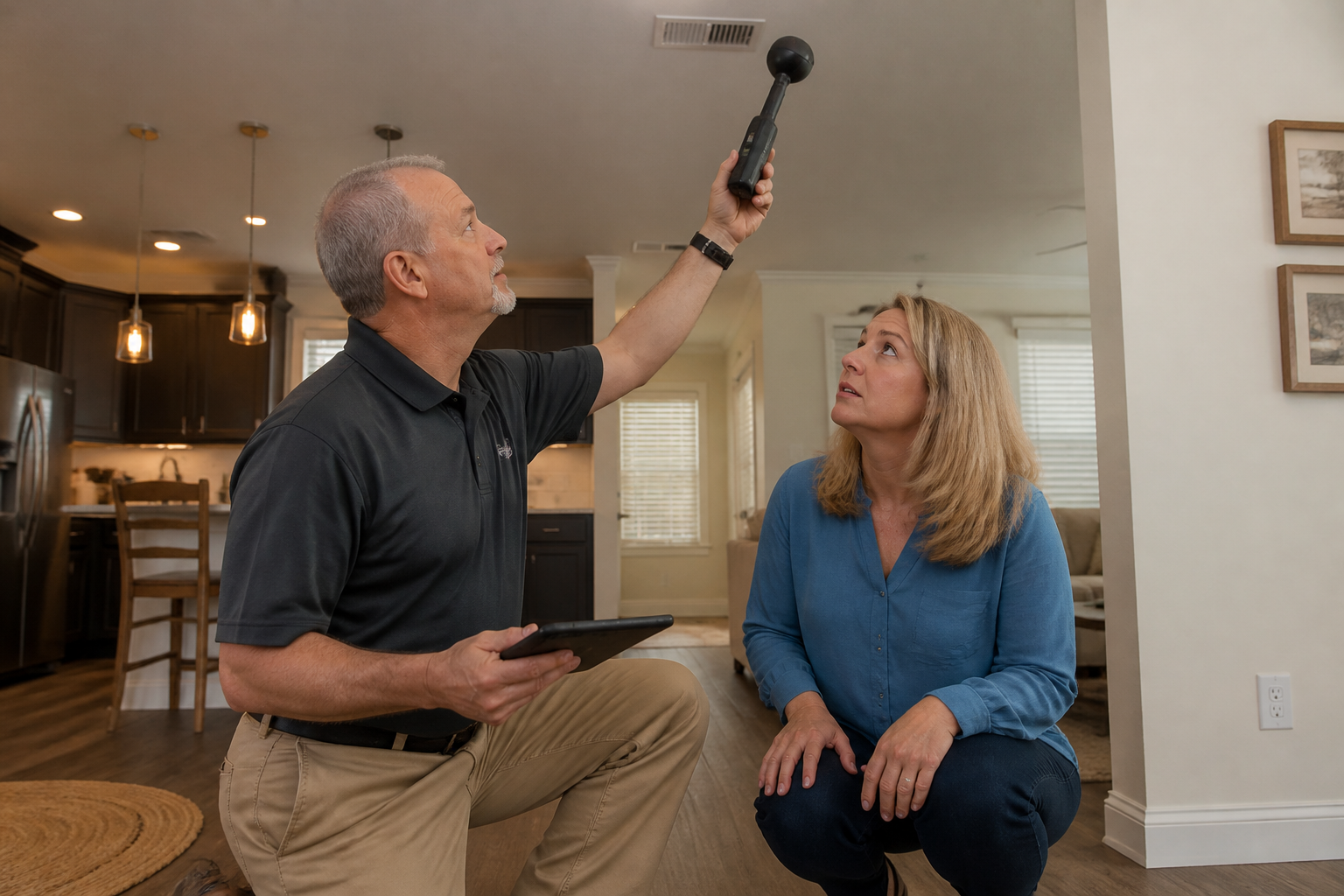
If you’re weighing mold testing vs. mold inspection in Sun City, AZ, consider starting with an inspection when you don’t know where a moisture problem is coming from or what may be affected. Testing may make sense when you have a specific question that inspection alone can’t answer, such as whether suspected material contains mold or whether sampling is appropriate in a particular area.
The two services are related, but they answer different questions. An inspection looks for signs of moisture and possible mold conditions; testing gathers samples to assess mold in the locations or materials included in its scope. Neither a stain nor a test result, by itself, tells the whole story about the source, extent, or cause of a problem.
Begin by identifying visible moisture, staining, or a possible leak. An inspection can help assess the conditions and guide next steps; testing is most useful when there is a clear reason to collect samples and a defined question those results can help answer.
What a mold inspection can help you understand
A mold inspection is generally a condition-focused assessment. Depending on the property and the scope of the service, an inspector may look for visible growth, water staining, damp or damaged materials, and areas where moisture may be entering or lingering. The findings can help point to places that need further attention.
An inspection does not necessarily confirm what a discolored patch is, and it may not reveal mold concealed inside a wall or another enclosed space. A lack of visible growth also does not prove that no hidden moisture issue exists. If a roof leak, plumbing leak, or other water intrusion is suspected, finding and addressing that source is an important part of the response.
For a Sun City property owner, an inspection may be a reasonable first step if there is an unexplained musty odor, recurring staining, a history of water damage, or concern about a particular room. These signs can have causes other than mold, so they are reasons to investigate—not proof that mold is present.
What mold testing can—and cannot—tell you
Mold testing involves collecting and assessing samples according to the service’s scope. The approach may vary based on the question being investigated and the conditions at the property. Testing might be considered when a homeowner needs information about suspected growth, wants to investigate a particular area, or needs results to help inform a next step.
Results need context. A sample reflects the material or area sampled at a particular time; it does not automatically establish the full extent of a problem or identify its moisture source. Testing can also be unnecessary if visible mold and a clear source of water already make the needed repair and cleanup apparent. The EPA’s guidance on identifying a possible mold problem explains why visual signs and moisture conditions matter when assessing a home.
For more background on what testing providers offer, explore the mold testing service category. A useful conversation with a provider should clarify what question testing is intended to answer, which areas or materials are included, and how the results will be explained.
When should you consider testing first?
Testing may be worth discussing before or alongside an inspection when there is a specific reason to collect samples. For example, you may have suspected growth in a location that is difficult to assess visually, or you may need information about a specific material. A provider can help explain whether sampling fits the situation and what it can reasonably establish.
Testing is not a substitute for finding and correcting moisture. If a leak remains active, results won’t fix the underlying condition. The EPA’s guide to mold, moisture, and the home discusses the connection between moisture control and reducing mold growth.
Practical steps before arranging service
Before scheduling an inspection or testing, make a simple record of what you have observed. This can help focus the discussion without disturbing materials or attempting to diagnose the cause yourself.
- Note where you see discoloration, peeling, damaged materials, or recurring dampness.
- Write down when the issue appeared and whether it changes after rain, plumbing use, or another event.
- Look for an obvious moisture source, such as a plumbing leak or roof leak, without opening walls or pulling up flooring.
- Take photographs of visible changes and keep any relevant repair or water-damage records.
- Avoid scrubbing or disturbing suspected mold, especially if doing so could spread dust or damage materials.
If there is active water intrusion, arrange to address the source. Keep affected areas from staying wet where it is safe and practical to do so, and ask a qualified provider for guidance if the materials or extent of damage are unclear.
How inspection and testing can work together
Sometimes the choice is not one service or the other. An inspection may identify areas of concern and help determine whether testing would add useful information. In other situations, a clearly defined testing request may be appropriate as part of a broader investigation.
Ask what the proposed service includes and what it does not. Find out whether the provider will explain observations separately from test findings, how sampling locations are selected, and what follow-up may be needed if moisture or mold is identified. If the concern points to cleanup or repair, ask how mold remediation fits into the next steps. The goal is to understand the conditions and respond to the moisture issue—not to treat a sample result as a complete assessment of the property.
ALM Services lists mold testing, mold inspection, and mold remediation among its services. You can review the ALM Services directory listing or visit the ALM Services website to discuss which service may fit your concern in Sun City.
Frequently Asked Questions
Is mold testing always necessary if I see mold?
No. Testing may not add useful information when growth is visible and the moisture source and affected area are already clear. A provider can help determine whether sampling would answer a specific question.
Can a mold inspection find mold inside a wall?
An inspection may identify clues that suggest hidden moisture or growth, but a visual assessment cannot always confirm what is inside an enclosed space. Further investigation may be needed, and any additional steps should be based on the conditions found.
Does a musty odor mean my Sun City home has mold?
Not by itself. An unusual odor can justify looking for moisture or other causes, but it does not prove mold is present. Note where and when you notice it and share that information during an inspection.
Should I test before fixing a leak?
Addressing an active leak should not be delayed while waiting for a test. Correcting the moisture source is a key step; inspection or testing can help assess concerns about affected materials and guide appropriate follow-up.
Need Mold Testing in Sun City?
If you’re concerned about moisture or possible mold in your property, ALM Services can help evaluate the situation and determine appropriate next steps.
ALM Services
Call: 602-257-8000





Leave a Reply