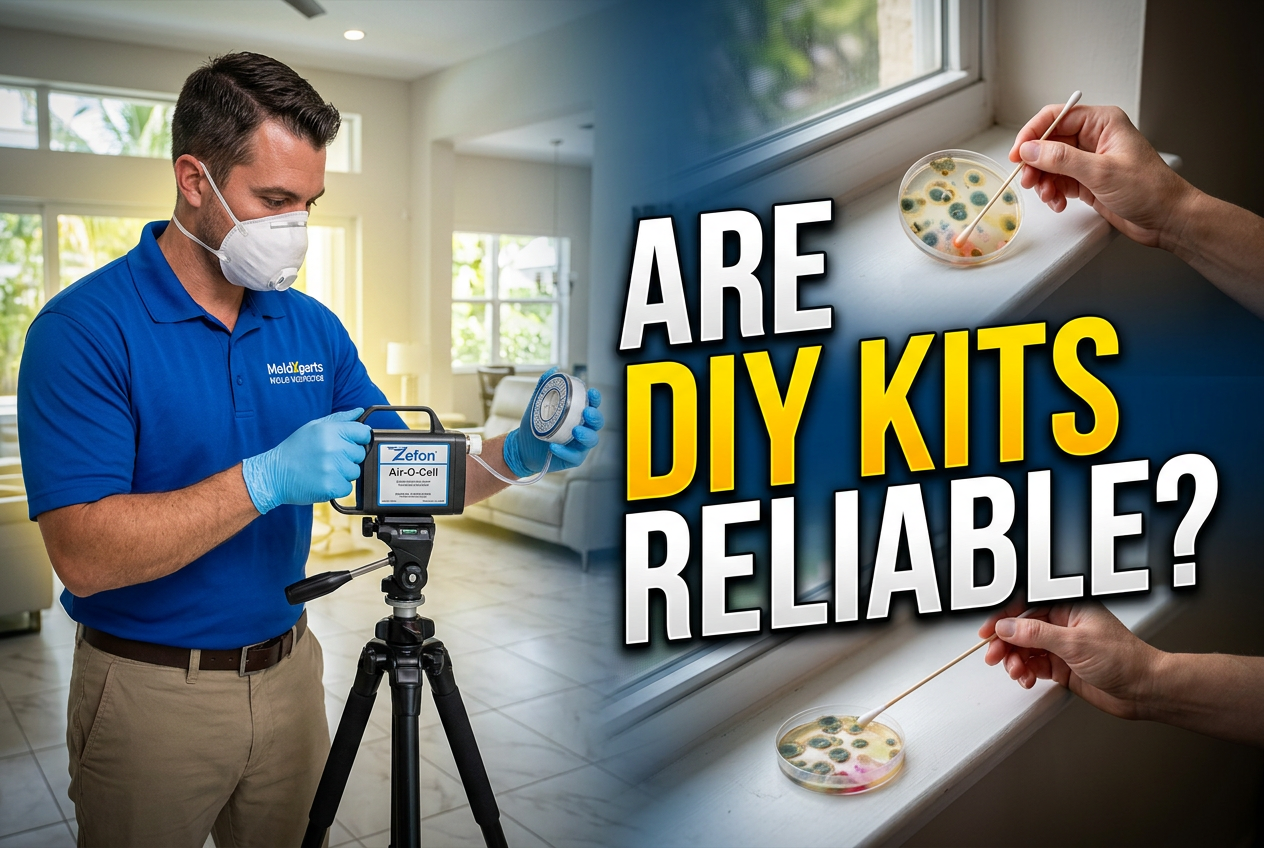
DIY Mold Test Kit vs. Independent Mold Testing in a Fort Lauderdale Home: What the Results Can—and Cannot—Tell You
When you notice a musty smell, a water stain, or suspected mold in your Fort Lauderdale home, a store-bought test kit may seem like a quick way to get an answer. But the result can be difficult to interpret without knowing what was sampled, where it came from, and what was happening in the home at the time. Independent mold testing can be more useful when it is guided by an inspection and a specific question about a moisture problem.
Key Takeaways
- A DIY kit may detect mold in the particular sample collected, but it generally cannot determine the source or extent of a moisture problem.
- A negative result does not prove a home is mold-free; sampling captures only a limited place and moment.
- An independent inspector can assess visible conditions, moisture clues, and whether sampling is likely to answer a useful question.
- In Fort Lauderdale, humidity, air-conditioning performance, plumbing leaks, and heavy rain can all contribute to indoor moisture concerns.
What a DIY mold test kit usually measures
Many consumer kits use a settle plate: a dish is left open so particles from the air can land on it. Other kits ask you to collect a surface sample with a swab or tape. Depending on the kit, you may mail the sample to a laboratory or interpret a basic result yourself.
These methods can indicate that mold-like material was present in the sample. A laboratory may identify types of mold or report what grew under its test conditions. That information is not automatically a diagnosis of a building problem. Mold spores can be present in indoor and outdoor air, and a single sample does not explain whether growth is active, where it originated, or whether a moisture issue remains.
Results also depend on how and where the sample was collected. A plate placed near an open window, an air-conditioning supply, or a recently disturbed area may produce a different result from one collected elsewhere. A surface swab only represents the specific spot sampled. Follow the kit instructions carefully, but remember that following them cannot make a limited sample answer questions it was not designed to answer.
What the result can—and cannot—tell you
A positive result may confirm that mold or mold-like growth was captured in that sample. It does not, by itself, establish the size of a problem, identify the source of moisture, or show whether concealed areas are affected. A lab report naming particular mold types also does not necessarily determine the cause of a smell or stain.
A negative result has limits, too. The sample may have missed the affected area, spores may not have been airborne during collection, or conditions may have changed since the concern began. A negative kit result should not override visible growth, recurring water intrusion, or a persistent musty odor.
There is no single consumer test result that, on its own, establishes whether a home is safe or unsafe. Interpretation depends on the property’s condition, the sampling method, the question being investigated, and other evidence such as moisture and water damage.
Why Fort Lauderdale homes may need a closer look
South Florida’s warm, humid conditions can make moisture management an ongoing concern. In Fort Lauderdale, heavy rain, wind-driven water, plumbing leaks, condensation, and air-conditioning or drainage problems may all contribute to damp materials. A home can also feel dry while moisture remains behind a cabinet, beneath flooring, or inside a wall assembly.
Pay attention to recurring clues rather than relying on one test result. These may include a musty odor that returns after cleaning, bubbling or discolored paint, warped baseboards, damp cabinetry, repeated condensation, or a stain that grows after rain. A roof or window leak may be intermittent, so the location and timing of water marks can be useful information.
These signs do not prove that mold is present, and the absence of visible growth does not rule out a concealed moisture issue. They can, however, help you decide whether to investigate the source rather than simply repeat a home test.
What independent mold testing may involve
An independent mold inspection typically begins with questions about the property and the concern: when the odor started, whether there has been a leak, which rooms are affected, and whether the problem changes with rain or air-conditioning use. The inspector may visually assess accessible areas and look for moisture conditions that could support mold growth.
Depending on the situation, an inspection may include moisture measurements, indoor air quality testing, or targeted sampling. Thermal imaging may be used as part of a mold and moisture inspection to identify temperature patterns that warrant closer evaluation. It does not see mold through walls or prove that a hidden area is wet; findings need to be interpreted alongside other observations and measurements.
Sampling is not necessary in every case. If growth is visible and the immediate question is where water is entering, locating and addressing the moisture source may be more useful than collecting a broad set of samples. When testing is appropriate, the inspector should be able to explain what question each sample is intended to answer and the limitations of interpreting the results.
Choosing between a kit and professional testing
A DIY kit may be a reasonable starting point for someone who wants to learn whether a particular sample contains mold-like material. It is less useful when you need to understand a persistent odor, identify a possible moisture source, evaluate a suspected hidden area, or document conditions for a property decision.
Consider an independent inspection when you have recurring water intrusion, visible growth beyond a small isolated area, a persistent musty odor, or uncertainty about what to do after a kit result. It may also be helpful before or after a real estate transaction if there is a specific concern to evaluate. Ask what the inspection includes, whether sampling is recommended, how results will be explained, and whether the inspector provides independent inspection and testing rather than selling remediation work.
MoldXperts provides independent mold inspection and testing, indoor air quality testing, and thermal imaging as part of mold and moisture inspections in Broward, Miami-Dade, and Palm Beach counties. The company does not provide mold remediation or mold removal. An independent assessment can help clarify observed conditions without combining the inspection with a sale of remediation services.
Practical next steps for Fort Lauderdale homeowners
- Photograph stains or visible growth and note when odors or dampness occur.
- Look for obvious moisture sources, such as a plumbing leak, water intrusion after rain, or recurring condensation. Avoid opening walls or disturbing suspected growth just to collect a sample.
- Address active leaks promptly through an appropriate repair professional, and keep records of water events and repairs.
- If the concern persists or the source is unclear, consider an independent inspection to determine whether testing may help answer a specific question.
A test kit can provide a limited piece of information, but it is not a complete assessment of a Fort Lauderdale home. The most useful next step is usually the one that helps explain the moisture conditions and the evidence at the property.
Watch: MoldXperts on YouTube
Visit the MoldXperts YouTube channel for more information about mold inspection and testing.
Request an independent mold inspection in Fort Lauderdale
If you have a persistent odor, water staining, visible growth, or questions about a DIY test result, contact MoldXperts to discuss independent mold inspection or testing in Fort Lauderdale and the surrounding South Florida area. Call (954) 464-4538 or visit the website to learn more.


Leave a Reply