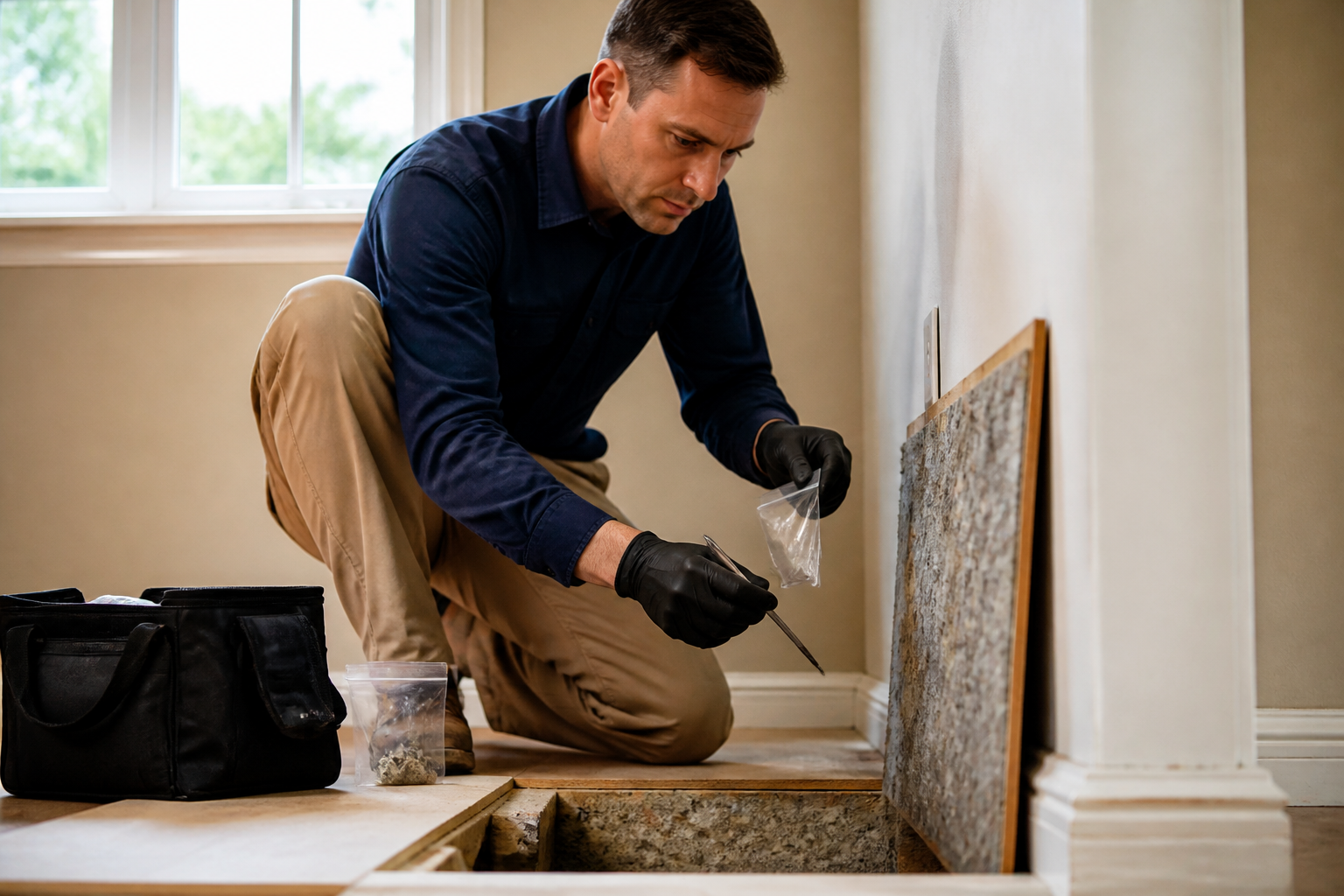
Before opening walls, replacing flooring, or removing old finishes in a Bethesda home, identify materials that the renovation may disturb. Some building products have contained asbestos, but appearance and age alone cannot confirm whether a material contains it. If suspect materials are part of the planned work, asbestos testing before renovation in Bethesda, MD, can help clarify what they are before a contractor begins disturbing them.
Quick Takeaway: If renovation work may disturb a material that could contain asbestos, do not cut or remove it to check. Arrange appropriate testing before work begins so the project plan can reflect the results.
Why consider asbestos testing before renovation?
Asbestos was used in a range of building materials. Whether a product in a particular home contains asbestos cannot be reliably determined by looking at it. The key renovation question is whether a material that may contain asbestos will be disturbed by the planned work.
When intact material is left alone, it may not require the same response as material that will be cut, drilled, sanded, scraped, or removed. Renovation can change that situation by breaking or damaging materials and releasing fibers. The U.S. Environmental Protection Agency explains that homeowners should avoid disturbing suspected asbestos-containing materials and consult qualified professionals when work may affect them.
Testing can provide useful information for planning. Depending on the findings, the owner and contractor can discuss whether to change the work scope, leave a material undisturbed, or seek further professional guidance before proceeding.
Materials to discuss when planning work
Some older building products have been made with asbestos, but no particular material should be assumed to contain it based on its appearance or the home’s age. Examples of materials that may warrant discussion if they are in the work area include:
- Some resilient floor tiles, sheet flooring, or flooring adhesives
- Some insulation around pipes, boilers, or ducts
- Some textured coatings, joint compounds, or plaster materials
- Some roofing, siding, or other exterior products
This is not a complete list, and similar-looking products can have different compositions. Layers can also matter: a renovation may affect an adhesive or backing beneath a visible finish. A professional can help determine which materials and locations should be considered for sampling based on the planned work.
Start with the renovation scope
Before arranging testing, identify what the project is expected to disturb. A kitchen update that leaves walls and flooring intact may raise different questions from a project involving demolition, new wiring, or floor removal. Share plans, contractor notes, or drawings when available, and point out the areas where materials will be cut, drilled, lifted, or removed.
A focused assessment can help connect testing to the actual project instead of treating every material in the home as a concern. If work changes after testing, ask whether the additional area or material should also be evaluated before it is disturbed.
Do not collect a sample yourself
Sampling may involve disturbing a small piece of material, so it is not a do-it-yourself task. Do not scrape, cut, drill, sand, break, or remove a suspect material to collect a sample or “check” what it is. Avoid sweeping or vacuuming debris from a material that has been damaged. Keep people away from the area and seek qualified professional guidance about what to do next.
Appropriate testing generally involves collecting a sample of the material and having it analyzed by a laboratory. The sample needs to represent the relevant material and location. If a project involves different materials, layers, or rooms, one result may not answer every question. Ask the testing professional what the proposed sampling covers and how results will be reported.
The EPA’s guidance on protecting your family from asbestos exposure offers additional background on avoiding disturbance and getting help with suspected materials.
How results can inform the next steps
Share the report with the renovation contractor before work begins, and make sure it is clear which material and location each result refers to. If asbestos is identified, discuss the findings with qualified professionals and determine how the planned work should proceed. Depending on the material and project, options may include revising the scope to avoid disturbance or arranging appropriate handling before renovation continues.
A negative result applies to the sample that was analyzed; it does not automatically establish the contents of other materials or locations that were not sampled. If the report does not cover all areas the project will disturb, ask whether additional evaluation is appropriate.
For homeowners comparing options, the MD Mold Testing directory listing provides contact information for the company’s asbestos testing service. You can also visit MD Mold Testing to ask about discussing a project before renovation work starts.
When should Bethesda homeowners arrange testing?
Consider addressing asbestos questions during project planning—before demolition, material removal, or other disturbance begins. Early testing gives you more time to understand the findings and coordinate with your contractor. It may be especially useful when renovation plans involve older finishes, concealed layers, or materials whose composition is unknown.
If a material is damaged unexpectedly during work, stop activity in the immediate area and avoid disturbing the debris. Contact a qualified professional for guidance rather than trying to identify or clean it yourself.
Frequently Asked Questions
Can I tell whether a material contains asbestos by looking at it?
No. Appearance alone cannot confirm asbestos content. Testing an appropriate sample through laboratory analysis may be needed to determine whether a specific material contains asbestos.
Should I test every material in my home before renovating?
Not necessarily. Testing decisions are usually tied to the materials and locations that the planned work may disturb. Discuss the project scope with a qualified professional to determine what should be considered.
What if the renovation contractor has already started?
If suspect material is unexpectedly encountered or damaged, pause work in the affected area and do not disturb or clean up the material yourself. Seek qualified professional guidance before work resumes there.
Does one negative test cover other rooms or materials?
Not automatically. A result applies to the sample analyzed. Ask which material and location were sampled and whether other parts of the renovation scope need separate evaluation.
Planning Asbestos Testing Before a Bethesda Renovation?
Contact MD Mold Testing to discuss asbestos testing for materials your renovation may disturb. Call to ask about next steps before work begins.
MD Mold Testing
Call: (301) 717-1454



Leave a Reply