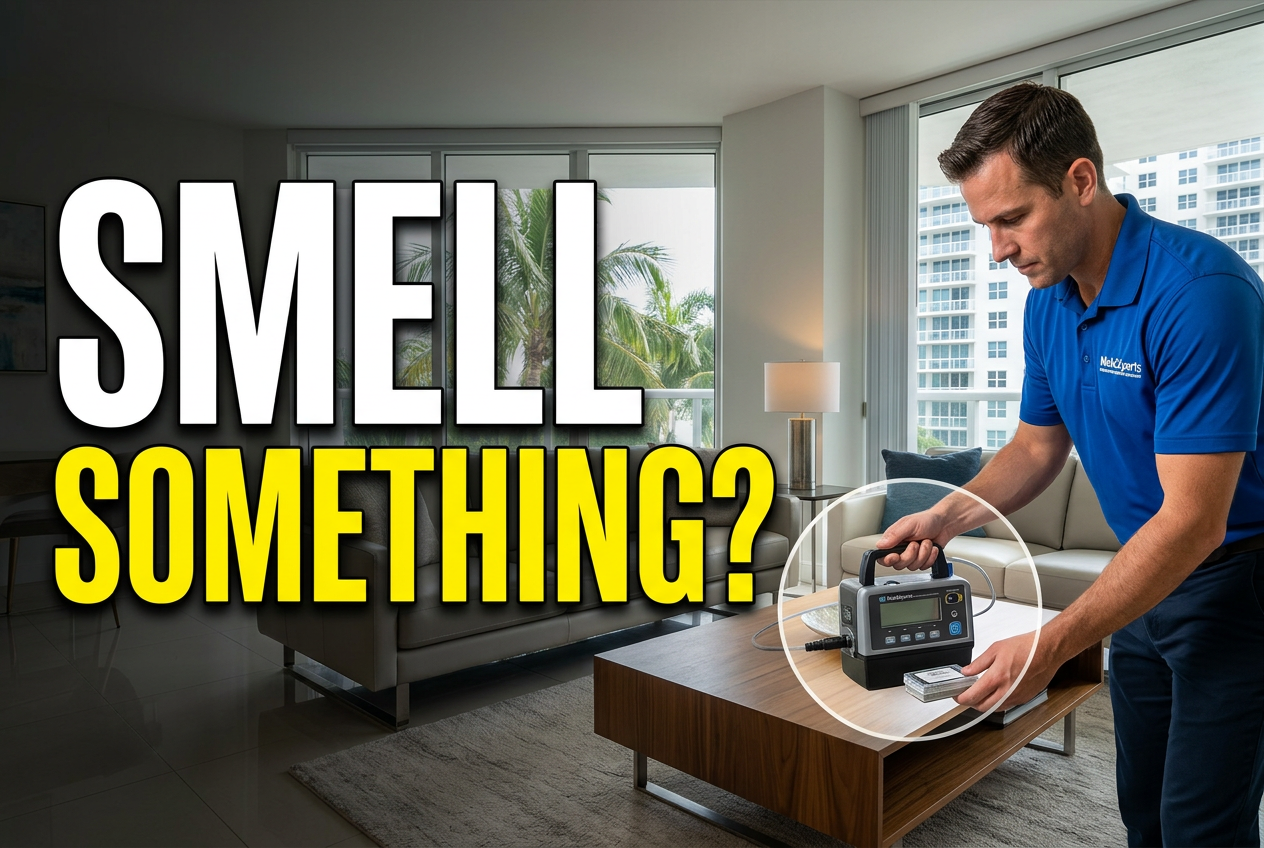
A persistent odor in a Delray Beach condo can be frustrating, especially when you cannot see mold or identify an obvious source. A musty smell may be associated with damp materials or hidden microbial growth, but odor alone cannot confirm mold. Other possibilities include plumbing or drain issues, HVAC conditions, household products, cooking, or odors traveling from another unit. Understanding what an inspection or indoor air quality testing can—and cannot—establish can help you choose a sensible next step.
Key Takeaways
- A lingering odor is a reason to investigate, but it does not by itself prove that mold is present.
- Odors can come from moisture, HVAC equipment, plumbing, products, or neighboring spaces.
- Testing is most useful when its purpose, locations, methods, and limitations are explained in advance.
- A professional inspection may look for moisture conditions and visible concerns; thermal imaging can help identify temperature patterns but does not confirm mold.
What a persistent odor may mean
Odors are clues, not diagnoses. A musty or earthy smell can occur where building materials have been damp, including areas that are not readily visible. In a condo, possible locations include the space around a sink or tub, a closet against an exterior wall, a ceiling below another unit, or areas near air-conditioning components. South Florida’s humid climate makes moisture management an important part of building maintenance, but it does not mean that every odor is caused by mold.
Other sources may produce persistent or intermittent smells. Floor drains or plumbing traps that have dried out, a leak or sewer-gas issue, residue in an air handler or drain line, cleaning products, furnishings, or odors entering through shared walls and ventilation pathways are examples. A smell that changes when the air conditioner runs, after a neighbor cooks, or when windows are opened may provide useful clues about where to investigate. These patterns are not proof of a particular source, however.
If you suspect a gas leak or another immediate safety concern, leave the area and contact the appropriate emergency or utility service. For plumbing concerns, a qualified plumbing professional may be needed. Mold inspection and air testing do not replace those evaluations.
When indoor air quality testing may help
Indoor air quality testing in Delray Beach, FL, may be worth discussing when an odor persists and a homeowner or property manager needs a clearer, documented assessment. It can be especially helpful when there are signs of past or current moisture, an odor that remains after routine cleaning, a history of leaks, or a concern about conditions in a particular room. Testing may also be considered when a buyer, owner, or landlord wants an independent evaluation before deciding what additional investigation is appropriate.
The first step should be defining the question. Is the goal to investigate a musty odor, assess a room with a known leak history, or compare indoor conditions with an outdoor reference? A professional should explain whether sampling is appropriate for that question or whether an inspection and moisture evaluation should come first. A sample taken without a clear purpose may provide numbers without answering why an odor is present.
Air sampling can provide information about airborne particles collected at a specific place and time. It is not a complete inventory of every condition in a condo, and a result cannot, on its own, establish the source of an odor or prove that a building is free of mold. Conditions can vary between rooms and change over time. If the suspected issue is inside a wall, under flooring, or within an HVAC component, a single air sample may not reveal it. Any sampling plan should be tailored to the observed conditions and the questions being asked.
What to ask about the scope
Before scheduling indoor air quality testing, ask the inspector to describe the proposed scope in plain language. Useful questions include:
- What question is the inspection or test intended to answer? Ask how the proposed work relates to the odor and any known moisture history.
- Which areas will be assessed, and why? Discuss the room where the odor is strongest, nearby bathrooms or kitchens, HVAC-related areas, and any locations affected by a past leak.
- Will the visit include a visual and moisture assessment? Ask what accessible areas will be examined and how moisture conditions will be evaluated.
- Is thermal imaging included, and what does it show? Thermal imaging can help identify temperature differences that may warrant closer investigation. It does not see through walls or identify mold, and findings need to be interpreted alongside other observations.
- What sampling method is proposed? Ask whether samples are air, surface, or another type, what locations are planned, and why those locations are relevant.
- How are samples analyzed and reported? Ask who performs any laboratory analysis, what the report will include, and how results will be interpreted. A report should describe the methods and limitations rather than imply that a sample gives a definitive all-clear.
- What happens if the inspection finds a concern? Ask whether the findings may indicate a need for a separate evaluation, such as a plumber or HVAC professional, or further investigation by an appropriate specialist.
Condo access and shared building systems can affect what is possible. A suspected source may be in a neighboring unit, a common area, or a building system managed by the association. Tell the inspector about the odor’s timing, location, and changes, and share relevant maintenance or leak records. If access to another area may be necessary, coordinate with the owner, property manager, or association.
Reasonable steps before the appointment
Keep a brief odor log: note the time, location, intensity, weather, air-conditioning use, and any activities that seem connected. Look for visible water staining, condensation, bubbling paint, or a recent leak, but avoid opening walls or disturbing suspect material yourself. Make sure the inspector knows about recent cleaning or use of scented products, as these can affect observations. Do not rely on air fresheners to solve a persistent problem; they may mask a smell without addressing its source.
Do not treat a negative test result as proof that no moisture or mold issue exists anywhere in the unit. Likewise, a detected particle does not automatically explain the odor or establish that a particular source is present. Results need to be considered with the inspection observations, the sampling conditions, and the building’s history. If the odor remains, discuss what follow-up is appropriate rather than repeating tests without a clear question.
Choosing an independent inspector
An independent mold inspection and testing company can provide an assessment without also selling mold removal or remediation work. Independence can be useful when you want findings and recommendations separated from any remediation proposal. It does not mean that every company offering both inspection and remediation has a conflict of interest; the important point is to understand the provider’s role and how recommendations are made.
MoldXperts provides mold inspection, mold testing, indoor air quality testing, and thermal imaging as part of mold and moisture inspections in South Florida, including Palm Beach County and Delray Beach. The company does not provide mold remediation or mold removal. If you contact an inspector, describe the odor and ask what the visit will cover before deciding whether sampling is appropriate.
Watch: MoldXperts on YouTube
For more information, visit the official MoldXperts YouTube channel.
Arrange an inspection or testing discussion
If a persistent odor in your Delray Beach condo has no obvious explanation, a professional assessment may help clarify what conditions are observable and whether testing fits your concerns. Contact MoldXperts to discuss independent mold inspection or testing in Delray Beach and across Broward, Miami-Dade, and Palm Beach counties. Ask about the proposed scope, what it can establish, and what follow-up may be appropriate.


Leave a Reply