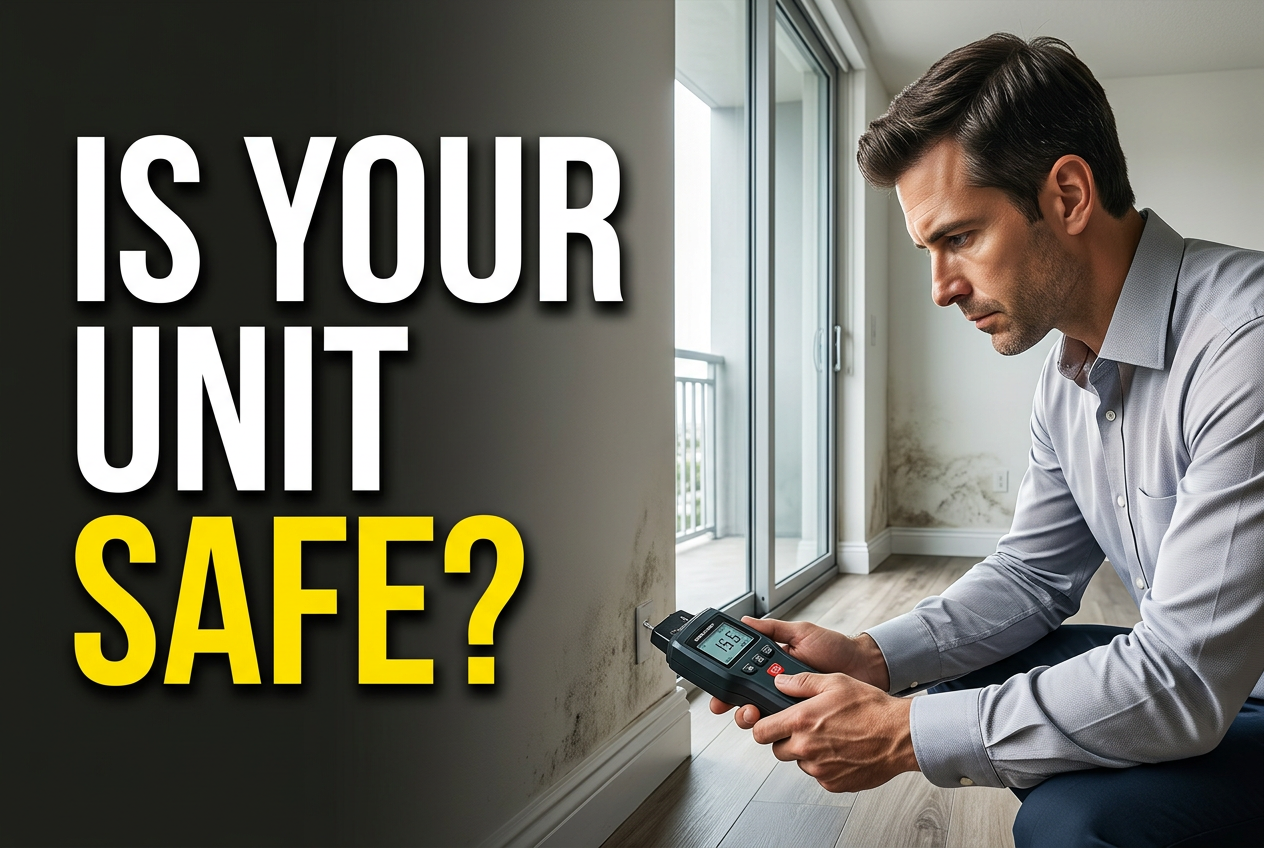
When a neighboring condo has a leak, it is reasonable to wonder whether water reached your Hollywood, Florida, unit. In attached buildings, moisture can sometimes travel through shared walls, ceilings, floors, plumbing chases, or other building assemblies. But a leak next door does not automatically mean your unit has water damage or mold. The extent of any effect depends on the leak’s location, duration, building construction, and how quickly the water was controlled and dried.
Key Takeaways
- A neighbor’s leak may affect an adjacent unit, but it does not establish that moisture or mold is present in yours.
- Look for staining, bubbling paint, musty odors, warped materials, or recurring dampness, and document changes.
- An independent inspection can assess accessible areas for visible concerns and signs of moisture; testing may be considered when it can help answer a specific question.
- Inspection findings do not, by themselves, determine where a leak originated or who is responsible for repairs.
How a leak in a neighboring unit could affect yours
Water does not always remain within the unit where a plumbing failure or appliance leak began. Depending on the building layout, it may move along a ceiling, down a wall cavity, beneath flooring, or through openings around pipes and utility lines. In a condo, the route can be difficult to predict without knowing the location of the leak and the construction details.
Some water migration is visible soon after an incident. Other signs may take time to appear, particularly if moisture is behind a finish or in a less accessible space. Conversely, a stain or odor in your unit may have another cause, such as an older leak, condensation, or a separate plumbing issue. An inspection can help assess observed conditions, but it should not assume that the neighboring leak is the cause without supporting evidence.
Signs to watch for inside your Hollywood condo
Pay attention to the ceiling, walls, floor edges, closets, and areas around plumbing fixtures that are near the reported leak. Relevant signs may include:
- New or spreading discoloration, water marks, or rings on ceilings or walls.
- Paint that is bubbling, peeling, or blistering, or drywall that appears swollen or soft.
- Warping, buckling, or lifting at flooring, baseboards, or trim.
- A persistent earthy or musty odor, especially in a closed room or cabinet.
- Visible spotting or repeated dampness in the same area.
These clues are reasons to investigate, not proof of mold. A surface can show water damage without visible mold, and a hidden moisture concern may not be obvious from appearance alone. If water is actively entering your unit, contact building management promptly and follow the property’s emergency procedures. Do not open walls or disturb suspect materials yourself.
What to do after learning about the leak
- Notify the appropriate people. Contact your condo association or property manager and, if applicable, your landlord. Ask whether the leak was stopped, what area was affected, and whether nearby units are being checked.
- Record what you observe. Take dated photographs or video of any visible changes. Note when you first noticed an odor, stain, or damp area and whether it changes over time.
- Keep communications in writing when practical. Share specific observations and ask how the building will coordinate access or follow-up. Building documents and association procedures may explain how common elements, plumbing, and unit interiors are handled.
- Consider an independent assessment if concerns remain. If you notice signs of moisture, have a persistent odor, or need a clearer picture of conditions inside your unit, an independent mold inspection in Hollywood, FL may help evaluate accessible areas and inform next steps.
If you rent, notify your landlord rather than making alterations or arranging intrusive work without permission. For insurance or building-related questions, keep inspection records and ask the appropriate insurer, association, or qualified professional about the process that applies to your situation.
What an independent mold inspection may assess
An independent inspector can conduct a visual assessment of accessible areas and look for conditions that may be consistent with moisture intrusion or mold growth. Depending on the circumstances, an inspection may include checking affected rooms and adjacent areas, evaluating visible building materials, and using moisture-measuring equipment to identify areas that warrant further attention. Thermal imaging may also be used as part of a mold and moisture inspection to help identify temperature patterns that could merit closer evaluation. It does not see through walls or confirm mold on its own.
When appropriate, mold testing or indoor air quality testing may be considered to address a particular concern. Testing is not automatically necessary in every case. The value of a sample depends on the question being asked, the sampling location and method, and how results are interpreted alongside the inspection findings. A test result is a snapshot of the conditions at the time and place sampled; it does not guarantee that every hidden area has been assessed.
MoldXperts is an independent mold inspection and testing company serving Hollywood and communities across Broward, Miami-Dade, and Palm Beach counties. Because the company does not provide mold remediation or mold removal, property owners can seek an inspection from a business that is not also selling remediation work. This is one option for obtaining an assessment; it does not mean that every company offering both inspection and remediation has a conflict of interest.
What an inspection or test cannot establish by itself
An inspection can document observed conditions and help identify areas for further attention, but it has limits. A non-invasive assessment may not reveal conditions concealed behind walls, under flooring, or inside closed building assemblies. Access may require coordination with the association, landlord, or neighboring unit owner.
Likewise, inspection findings or laboratory results alone may not establish the precise source or path of water, when an issue began, who is responsible, or the full extent of concealed damage. Those questions may require building records, additional access, or evaluation by other appropriately qualified professionals. An inspector’s report can provide useful information, but it is not a substitute for repairs, legal advice, or an insurance determination.
When to arrange an inspection
Consider professional assessment when you have persistent musty odors, visible water-related changes, recurring dampness, or uncertainty about whether an affected area inside your unit needs further evaluation. It may also be helpful if you want independent documentation of accessible conditions after a reported leak. If there are no signs in your unit, you can still ask management about the incident and monitor nearby areas; an inspection is a choice based on your observations and concerns, not an automatic requirement after every neighboring leak.
When requesting an inspection, explain where the neighboring leak occurred, when it was reported, what areas of your unit are nearby, and what you have noticed. Ask what areas can be assessed, whether testing is recommended for a specific reason, and what the findings can and cannot conclude. This helps keep the evaluation focused on your unit and the questions you need answered.
Watch: MoldXperts on YouTube
Visit the MoldXperts YouTube channel for information about mold inspection and testing.
Request an independent assessment in Hollywood, FL
If a neighboring condo leak has left you concerned about moisture or mold inside your unit, MoldXperts can discuss professional mold inspection and testing options in Hollywood and throughout Broward, Miami-Dade, and Palm Beach counties. Call (954) 464-4538 or visit moldxperts.com to learn more.



Leave a Reply