Can Thermal Imaging Find Moisture Behind Bathroom Tile? What a Plantation Mold Inspection Can—and Cannot—Reveal
A damp smell, loose bathroom tile, or recurring grout discoloration can raise a worrying question: is moisture trapped behind the tiled surface? In Plantation, Florida, heat and humidity can make moisture concerns especially important to investigate, but a thermal imaging camera cannot look through tile or confirm hidden water by itself. A professional mold inspection Plantation FL property owners arrange may use thermal imaging as one part of a broader assessment—not as a stand-alone answer.
Key Takeaways
- Thermal imaging shows surface temperature patterns; it does not see through tile or directly detect mold.
- A cool or unusual pattern can suggest an area for closer investigation, but other conditions can create similar patterns.
- Visual observations, moisture measurements, building history, and—when appropriate—sampling help put findings in context.
- Some concealed moisture may require further evaluation or limited opening of a building assembly to confirm.
What thermal imaging can reveal
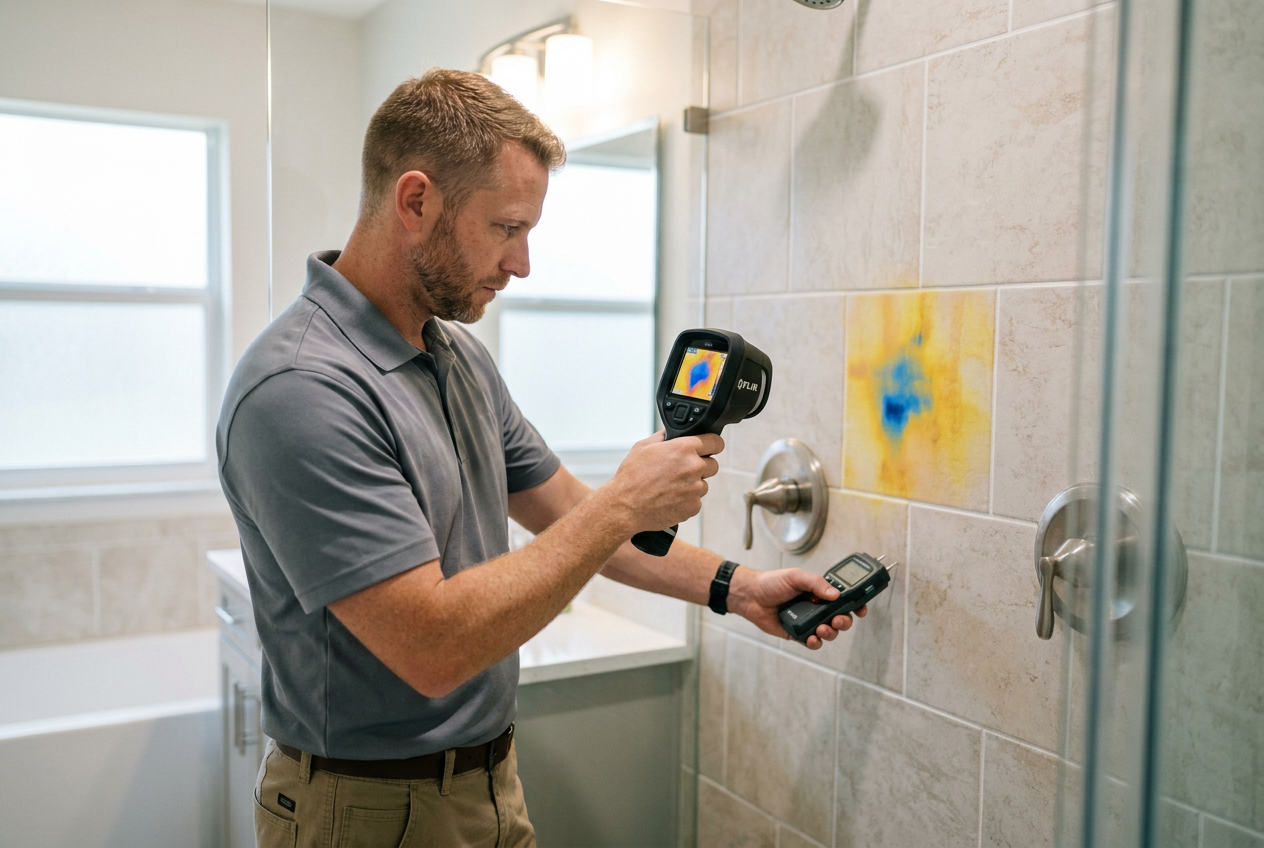
Thermal imaging, also called infrared imaging, records temperature differences across visible surfaces. During a bathroom assessment, an inspector may scan tile, walls, ceilings, or nearby flooring for patterns that differ from surrounding areas. Evaporation, wet materials, air leaks, plumbing conditions, and temperature changes can all affect a surface’s appearance on a thermal camera.
If a section of a tiled wall appears cooler than nearby areas, that pattern may be a reason to investigate further. It is not proof that the area behind the tile is wet. A cool pattern can have other explanations, including a pipe carrying cold water, a change in wall construction, airflow, shading, or a recent temperature change. Conversely, a thermal image that looks ordinary does not rule out moisture behind tile.
Thermal imaging is most useful when interpreted alongside the inspector’s observations and other appropriate tools. A trained inspector considers the conditions during the scan and whether the temperature pattern makes sense in light of the room’s layout, plumbing, and reported symptoms.
Why tile can make moisture difficult to assess
Tile is a finished surface, and the layers behind it may include grout, setting materials, a backer board, a waterproofing membrane, and framing or another wall assembly. The exact construction varies. Water can travel through gaps or failed joints and affect materials behind the visible surface, while the tile itself may remain intact.
Not every bathroom has the same waterproofing details, and grout is not necessarily a complete waterproof barrier. Cracked grout or sealant can be a clue to inspect, but it does not by itself establish that water has entered the wall. Likewise, intact-looking tile does not guarantee that everything behind it is dry.
Moisture can also come from sources other than the shower enclosure, such as a leaking supply or drain line, a toilet connection, or water entering from an adjoining space. The location and timing of a stain or odor may help guide the inspection, but they do not always identify the source on their own.
Warning signs worth documenting
Consider noting when and where you notice changes, especially if they recur. Relevant signs may include:
- A persistent musty odor near a shower, tub, vanity, or adjoining room.
- Loose, cracked, or shifting tiles, or grout and sealant that repeatedly deteriorate.
- Staining, bubbling paint, soft trim, or swelling on a nearby wall or ceiling.
- Water appearing outside the shower area or on the other side of a bathroom wall.
- A damp area that returns after cleaning or drying, or a history of plumbing leaks.
These signs do not prove that mold is present. They can, however, help an inspector understand where to focus and whether further moisture evaluation may be warranted. Photographing changes and keeping a simple record of when they occur can be useful.
What a Plantation mold inspection may include
An independent mold inspection generally begins with a discussion of the concern and a visual review of accessible areas. The inspector may ask about leaks, repairs, odors, ventilation, and when symptoms such as staining or dampness first appeared. Depending on the situation, the evaluation may include moisture measurements and thermal imaging as tools to identify areas for closer attention.
Thermal imaging is not a moisture meter. A thermal pattern can help identify a temperature difference, while appropriate moisture measurement can help assess accessible materials. Neither tool necessarily confirms what is inside a sealed wall or behind a tiled shower. An inspector may explain whether the available evidence is enough to support a conclusion or whether additional evaluation is needed.
Mold sampling may be considered when it is appropriate to the question being asked. Sampling has limits: results represent the locations and conditions sampled, and a test does not automatically identify the moisture source, locate every hidden growth area, or guarantee that no mold exists elsewhere. A negative result cannot, by itself, rule out a concealed problem. The findings need to be interpreted with the inspection observations and property history.
In some cases, confirming concealed conditions may require opening a small area or other access that goes beyond a non-invasive inspection. That decision should be discussed with the property owner, including the purpose, limitations, and who would perform any opening or repairs. A standard visual or thermal inspection should not be represented as a guarantee about every concealed surface.
Reasonable next steps for property owners
If you suspect a leak, address the water source promptly. A plumber may be appropriate when a supply, drain, or fixture leak is suspected. Avoid covering a recurring damp area with paint or caulk before its cause is understood, since that can obscure useful evidence without resolving the underlying condition.
For a bathroom concern, provide an inspector with relevant details: where the odor or staining occurs, whether it changes after showering, any known leak or repair history, and whether the problem affects an adjoining room. Keep the area accessible and avoid disturbing suspected mold before discussing the situation with a qualified professional.
Professional inspection may make sense when signs persist, the suspected area is concealed, a prior leak has occurred, or you need an independent assessment for a property decision. MoldXperts provides independent mold inspection and testing in Broward, Miami-Dade, and Palm Beach counties, including Plantation. The company does not provide mold remediation or mold removal. An independent inspection can help property owners receive an assessment from a company that is not also selling remediation work.
Watch: MoldXperts on YouTube
Visit the MoldXperts YouTube channel for informational content. No specific video is linked here because a verified, relevant video URL is not available.
Arrange an independent assessment in Plantation
If bathroom tile, recurring dampness, or a persistent odor has you concerned, a professional evaluation can help clarify what is observable, what remains uncertain, and whether further investigation or testing is appropriate. Contact MoldXperts at (954) 464-4538 to discuss mold inspection or testing in Plantation and across South Florida.




Leave a Reply