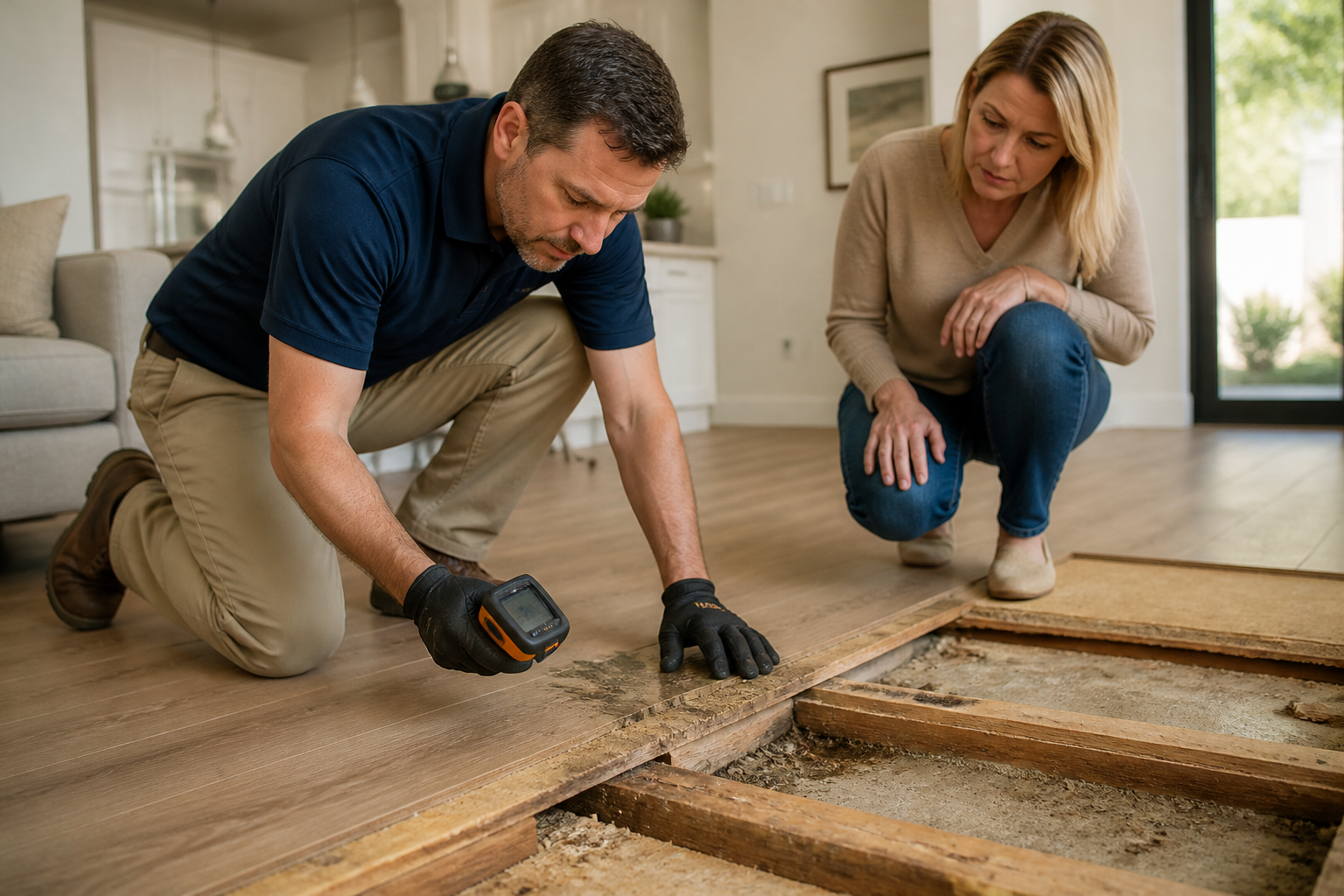
Soft, swollen, or buckling flooring in a Scottsdale home can be a sign that moisture has reached the flooring or subfloor. It does not prove that mold is present, but if the area has stayed damp, smells musty, or has a history of a leak, a mold inspection under flooring may help identify moisture concerns and determine whether further evaluation or testing is appropriate.
Changing floors can result from moisture, installation issues, or other causes, so appearance alone cannot confirm mold. Look for a possible water source and a pattern of continuing dampness; consider an inspection when the cause is unclear or signs persist.
Why floors can become soft or buckle
Flooring materials respond differently to moisture. Wood and wood-based products can swell or warp; laminate may lift at seams; and flooring over a damp subfloor can feel spongy or uneven. The condition may develop after a plumbing leak, an appliance overflow, water entering around a door or window, or another source of water intrusion.
Not every floor change is moisture-related. Installation defects, normal material movement, wear, and other building issues can also cause gaps, raised edges, or uneven areas. A soft spot may mean the layers beneath the finished floor have weakened, but it does not identify why. If the floor feels unstable, avoid placing heavy loads on it and seek qualified help to assess the flooring condition.
Moisture that remains in materials can create conditions in which mold may grow. However, buckling, discoloration, and musty odors are clues to investigate—not proof of mold or a way to identify a mold type. The EPA’s explanation of why mold grows indoors describes the role moisture plays.
Signs that hidden moisture may need investigation
Pay attention to changes in the affected area and whether they continue or return. One sign by itself may have several explanations, but a group of signs—or a known leak—can make a closer look worthwhile.
- A floor feels soft, spongy, or different from nearby areas.
- Boards, planks, or seams are lifting, swelling, separating, or buckling.
- There is visible staining, peeling, or discoloration near the floor or baseboards.
- A musty odor persists near the affected area, especially after the room has been aired out.
- There has been a leak, spill, or appliance overflow, and the floor still seems damp or changes over time.
Odor and staining can help point to an area for investigation, but neither confirms mold. The EPA’s guidance on how to tell if you have a mold problem also emphasizes that mold may not always be visible.
What a mold inspection under flooring can help clarify
A mold inspection is an evaluation of the area and its conditions; it is not the same thing as a laboratory test. An inspection may include reviewing the history of the problem, looking at accessible surfaces, and investigating moisture conditions with appropriate tools. The exact scope depends on the property and what can be safely accessed.
Floor coverings can conceal the subfloor, so a visual inspection from above cannot necessarily show what is beneath them. An inspector may identify signs that justify further evaluation, but accessing concealed materials may require permission and, depending on the situation, help from an appropriate flooring or building professional. Do not assume that every inspection involves removing flooring.
Mold testing is a separate step that may be considered when there is a specific question an inspection cannot answer, such as whether suspected growth is present in a particular area. Testing is not automatically needed for every soft floor or moisture issue. Discuss the reason for testing and how the results will be used before deciding on it. You can explore mold testing services if testing appears appropriate.
Practical steps for Scottsdale property owners
Start by recording what you can observe without pulling up flooring or disturbing suspected mold. Note when the change appeared, whether it is spreading, and whether it followed a known leak or spill. Photographs can help document visible changes over time.
- Check for an obvious source, such as a plumbing fixture or appliance near the affected floor, without taking apart building materials.
- Address an active leak through a qualified repair professional. Stopping the water source is essential to resolving a moisture problem.
- Keep track of whether the area remains damp, changes in size, or develops additional visible signs.
- Avoid lifting flooring or scraping suspected growth just to see what is underneath.
- If materials are wet, get appropriate guidance on drying and repair; concealed or extensive dampness may need professional assessment.
For general guidance on moisture and household materials, see the EPA’s brief guide to mold, moisture, and your home. If the floor is unstable or deterioration is suspected, an assessment of the flooring and subfloor may also be needed; a mold inspection does not replace a building or flooring evaluation.
When to contact an inspector
Consider a mold inspection when a floor remains soft or buckled after the suspected water source has been addressed, when moisture signs keep returning, or when an odor or visible change has no clear explanation. An inspection can help determine what is observable, where moisture concerns may be present, and whether mold testing or additional evaluation makes sense.
ALM Services offers mold inspection and mold testing for property owners in Scottsdale. To learn more about the provider, visit the ALM Services directory listing or the ALM Services website. If mold is identified and remediation is appropriate, the moisture source should also be addressed as part of resolving the underlying problem.
Frequently Asked Questions
Does a buckling floor mean there is mold underneath?
No. Buckling can have several causes, including moisture, but it does not confirm mold. An inspection can help assess conditions and determine whether testing is warranted.
Can mold be inspected without removing the flooring?
Some evaluation may be possible from accessible areas, but the finished floor can hide the subfloor. Whether further access is needed depends on the findings and the inspection’s scope.
Should I order mold testing as soon as I notice a soft spot?
Not necessarily. First consider whether there is an active or recent moisture source. An inspection can help clarify whether testing would answer a useful question.
What should Scottsdale homeowners do if the floor is still damp?
Address the water source and seek appropriate guidance about drying and assessing affected materials. Avoid disturbing concealed areas or suspected growth while the cause is being evaluated.
Need Mold Testing in Scottsdale?
ALM Services can help Scottsdale property owners evaluate mold concerns related to soft or buckling floors and consider whether mold testing is appropriate. Call to discuss the situation and possible next steps.
ALM Services
Call: 602-257-8000




Leave a Reply