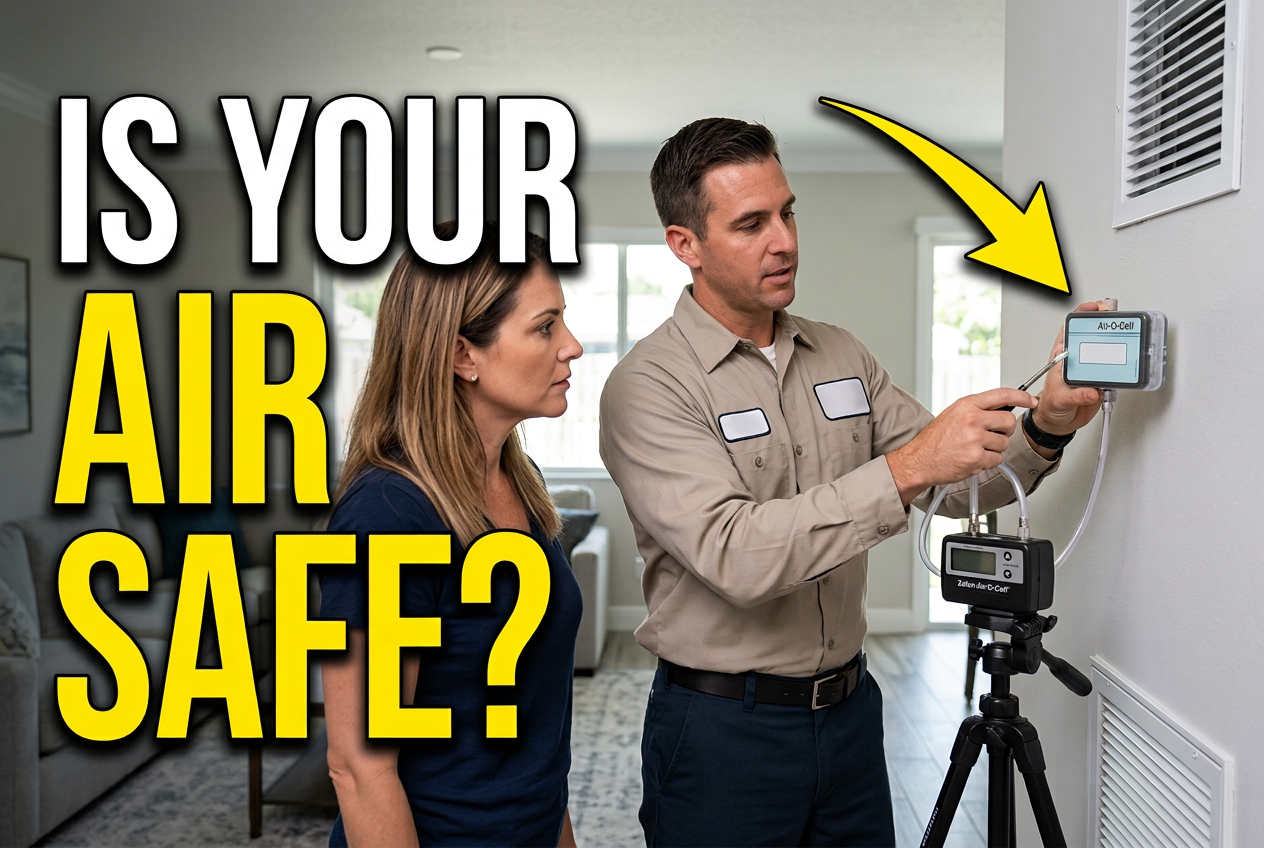
If you have received a mold air sampling report for your Pompano Beach home, the numbers and mold names may be difficult to interpret. A result is not a simple pass-or-fail verdict, and it does not by itself identify where moisture or mold growth is located. Understanding what was sampled, how indoor findings compare with outdoor air, and what conditions were present during testing can help you decide what to do next.
Key Takeaways
- Air samples show which airborne mold spores were detected and their estimated concentration at a particular time and location.
- Indoor results are often interpreted alongside an outdoor reference sample, not against one universal “safe” number.
- A sample is a snapshot; it cannot rule out hidden growth or establish the full condition of a property on its own.
- Moisture observations, building history, and the sampling plan matter when deciding whether further evaluation is needed.
What mold air sample results measure
Many indoor air tests use a spore-trap sampling device to collect airborne particles on a small collection surface. A laboratory examines the sample under a microscope and reports the types of spores identified and an estimated concentration, often expressed as spores per cubic meter of air. Reports may also list other fungal structures, such as hyphal fragments, depending on the laboratory and method.
These samples provide information about airborne particles in the sampled air during the collection period. They do not directly measure the amount of mold growing on a wall, inside an air-conditioning system, or behind a cabinet. A result also does not tell you whether a particular person will have symptoms. Mold testing is not a medical diagnosis, and health concerns should be discussed with a qualified health professional.
Why indoor and outdoor results are compared
Mold spores occur naturally outdoors and can enter a home through doors, windows, ventilation, and on clothing. For that reason, an inspector may collect an outdoor reference sample near the time indoor samples are taken. The comparison can help show whether the indoor air has a similar pattern to outdoor air or whether certain types or concentrations appear elevated indoors.
Interpretation is about more than comparing two totals. The types of spores, their relative abundance, the rooms sampled, and the property’s conditions all matter. For example, a higher indoor concentration of a particular spore type than the outdoor reference may warrant closer attention, especially if there is a musty odor or evidence of moisture in the area. It still does not prove the precise location or cause of a source.
There is no single number that applies as a universal boundary between “safe” and “unsafe” for every home. Results can vary with weather, season, outdoor conditions, ventilation, recent cleaning, and activity in the room. A useful report explains the sampling locations and conditions and interprets the findings in context rather than relying on one number alone.
What a result can—and cannot—establish
Air sampling can help document airborne conditions at selected locations and can support an investigation when there is a reason to suspect an indoor mold issue. It may be useful when a property has a persistent musty smell, a history of leaks, visible staining, or concerns that are not explained by a visual review alone.
However, a normal-looking or low air sample does not rule out mold growth. Growth may be concealed in a wall cavity, beneath flooring, or in another area that is not releasing many spores into the sampled air at that moment. Conversely, detecting spores does not automatically mean there is an indoor mold problem; outdoor spores can be present indoors, too. A test should be considered one part of a broader assessment, not a substitute for investigating moisture and the building.
Sampling also captures a limited period. A room’s conditions can change when a door opens, an air conditioner cycles, or people move through the space. A report should therefore be read with care, especially if only one sample was collected or the locations do not reflect the areas of concern.
Why Pompano Beach conditions deserve context
In Pompano Beach and across South Florida, warm, humid weather and heavy rain can make moisture management an important part of property care. Roof or plumbing leaks, water intrusion around windows, condensation, and air-conditioning drainage problems can all create conditions that deserve attention. A mold air sample cannot determine which of these issues, if any, is present.
When reviewing a report, consider the property’s recent history: Was there a leak, storm-related water intrusion, or an air-conditioning problem? Is there a persistent odor, visible discoloration, or recurring condensation? Has a room been closed off or recently cleaned? These details can help an inspector understand whether the sample results fit the rest of the evidence.
How to read your report and decide on next steps
- Check the basics. Note the date, sample locations, sampling method, outdoor reference results, and any limitations listed by the inspector or laboratory.
- Look at patterns, not just totals. Consider which spore types were found indoors and outdoors and whether any indoor pattern stands out in the context of the report.
- Connect findings to the building. Review odors, stains, leaks, condensation, and prior water events. A lab report does not replace looking for moisture sources.
- Ask what the findings mean for your specific concern. If the report is unclear, request an explanation of the sampling plan, the interpretation, and whether additional inspection is appropriate.
If there is visible growth or an active leak, do not rely on air testing alone to decide what is happening. The priority is to understand and address the moisture condition. If you are buying or selling a home, documenting concerns, or investigating a musty odor, an independent mold inspection may help clarify what can be observed and whether testing is likely to answer a specific question.
When professional mold testing may make sense
Professional mold testing in Pompano Beach, FL may be worth considering when there is a clear reason to evaluate indoor air, such as unexplained odors, a history of water intrusion, or concerns after an initial inspection. A qualified independent inspector can review the property, identify visible moisture concerns, discuss what testing can and cannot answer, and select sample locations based on the purpose of the assessment. Thermal imaging may be used as part of a mold and moisture inspection to identify temperature patterns that merit further investigation; it does not confirm mold by itself.
MoldXperts provides independent mold inspection, mold testing, indoor air quality testing, and thermal imaging as part of mold and moisture inspections in Broward, Miami-Dade, and Palm Beach counties. The company does not provide mold remediation or mold removal. Independent testing can give property owners an assessment from a company that is not also selling remediation work, while keeping the focus on the inspection findings.
Watch: MoldXperts on YouTube
For more information about mold inspection and testing, visit the MoldXperts YouTube channel.
Discuss your Pompano Beach testing questions
If you have an air sample report and want help understanding what it does—and does not—show, contact MoldXperts to discuss an independent mold inspection or testing in Pompano Beach. Call (954) 464-4538 or visit moldxperts.com to learn more about service availability in Broward, Miami-Dade, and Palm Beach counties.



Leave a Reply